How Is Nuclear Energy Affecting the Environment Peer Reviewed
Many environmentalists have opposed nuclear power, citing its dangers and the difficulty of disposing of its radioactive waste material. But a Pulitzer Prize-winning author argues that nuclear is safer than nearly free energy sources and is needed if the world hopes to radically subtract its carbon emissions.
In the late 16th century, when the increasing price of firewood forced ordinary Londoners to switch reluctantly to coal, Elizabethan preachers railed against a fuel they believed to be, literally, the Devil'southward excrement. Coal was black, after all, muddied, found in layers underground — down toward Hell at the center of the world — and smelled strongly of sulfur when information technology burned. Switching to coal, in houses that commonly lacked chimneys, was difficult enough; the clergy's outspoken condemnation, while certainly justified environmentally, further complicated and delayed the timely resolution of an urgent problem in free energy supply.
For too many environmentalists concerned with global warming, nuclear energy is today'south Devil's excrement. They condemn it for its product and use of radioactive fuels and for the supposed problem of disposing of its waste. In my judgment, their condemnation of this efficient, depression-carbon source of baseload energy is misplaced. Far from being the Devil's excrement, nuclear ability can be, and should be, one major component of our rescue from a hotter, more meteorologically destructive world.
Like all energy sources, nuclear power has advantages and disadvantages. What are nuclear ability'south benefits? Outset and foremost, since it produces energy via nuclear fission rather than chemical called-for, it generates baseload electricity with no output of carbon, the villainous chemical element of global warming. Switching from coal to natural gas is a step toward decarbonizing, since burning natural gas produces virtually half the carbon dioxide of burning coal. But switching from coal to nuclear ability is radically decarbonizing, since nuclear power plants release greenhouse gases only from the ancillary use of fossil fuels during their structure, mining, fuel processing, maintenance, and decommissioning — about as much as solar power does, which is nearly 4 to v percent equally much as a natural gas-fired power plant.
Nuclear power releases less radiation into the environment than any other major free energy source.
Second, nuclear ability plants operate at much higher capacity factors than renewable energy sources or fossil fuels. Capacity factor is a measure of what percent of the time a power plant actually produces energy. It'southward a problem for all intermittent energy sources. The sun doesn't always shine, nor the current of air ever blow, nor h2o always fall through the turbines of a dam.
In the United States in 2016, nuclear power plants, which generated almost 20 percentage of U.S. electricity, had an average capacity factor of 92.3 percent, pregnant they operated at full ability on 336 out of 365 days per year. (The other 29 days they were taken off the grid for maintenance.) In dissimilarity, U.South. hydroelectric systems delivered power 38.ii percent of the fourth dimension (138 days per year), wind turbines 34.v percentage of the time (127 days per yr) and solar electricity arrays only 25.i percentage of the time (92 days per twelvemonth). Fifty-fifty plants powered with coal or natural gas only generate electricity about half the time for reasons such every bit fuel costs and seasonal and nocturnal variations in demand. Nuclear is a articulate winner on reliability.
Third, nuclear ability releases less radiation into the environment than any other major energy source. This statement will seem paradoxical to many readers, since it's not normally known that not-nuclear energy sources release whatever radiation into the environment. They practise. The worst offender is coal, a mineral of the earth's chaff that contains a substantial book of the radioactive elements uranium and thorium. Called-for coal gasifies its organic materials, concentrating its mineral components into the remaining waste product, called fly ash. So much coal is burned in the world and so much fly ash produced that coal is actually the major source of radioactive releases into the environment.
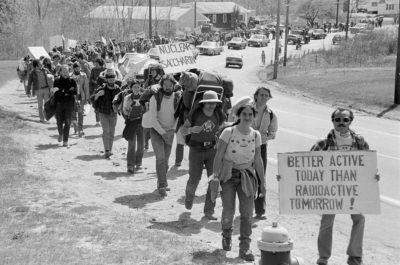
Anti-nuclear activists protest the construction of a nuclear power station in Seabrook, New Hampshire in 1977. AP Photograph
In the early on 1950s, when the U.South. Diminutive Free energy Commission believed high-grade uranium ores to exist in brusque supply domestically, information technology considered extracting uranium for nuclear weapons from the arable U.S. supply of fly ash from coal burning. In 2007, China began exploring such extraction, drawing on a pile of some 5.3 million metric tons of brown-coal fly ash at Xiaolongtang in Yunnan. The Chinese ash averages about 0.4 pounds of triuranium octoxide (U3O8), a uranium compound, per metric ton. Hungary and South Africa are also exploring uranium extraction from coal fly ash.
What are nuclear's downsides? In the public's perception, there are two, both related to radiations: the risk of accidents, and the question of disposal of nuclear waste.
At that place have been three large-scale accidents involving nuclear power reactors since the onset of commercial nuclear power in the mid-1950s: Three-Mile Island in Pennsylvania, Chernobyl in Ukraine, and Fukushima in Nippon.
Studies indicate fifty-fifty the worst possible blow at a nuclear establish is less destructive than other major industrial accidents.
The partial meltdown of the Three-Mile Island reactor in March 1979, while a disaster for the owners of the Pennsylvania plant, released merely a minimal quantity of radiation to the surrounding population. According to the U.Due south. Nuclear Regulatory Committee:
"The approximately two meg people around TMI-2 during the accident are estimated to accept received an boilerplate radiation dose of only about one millirem above the usual background dose. To put this into context, exposure from a chest X-ray is about 6 millirem and the expanse's natural radioactive background dose is about 100-125 millirem per year… In spite of serious damage to the reactor, the actual release had negligible effects on the physical health of individuals or the environs."
The explosion and subsequent burnout of a big graphite-moderated, water-cooled reactor at Chernobyl in 1986 was easily the worst nuclear accident in history. Twenty-nine disaster relief workers died of acute radiation exposure in the firsthand backwash of the accident. In the subsequent 3 decades, UNSCEAR — the Un Scientific Committee on the Effects of Atomic Radiation, composed of senior scientists from 27 fellow member states — has observed and reported at regular intervals on the health effects of the Chernobyl accident. It has identified no long-term health consequences to populations exposed to Chernobyl fallout except for thyroid cancers in residents of Republic of belarus, Ukraine and western Russian federation who were children or adolescents at the fourth dimension of the accident, who drank milk contaminated with 131iodine, and who were not evacuated. Past 2008, UNSCEAR had attributed some 6,500 excess cases of thyroid cancer in the Chernobyl region to the accident, with 15 deaths. The occurrence of these cancers increased dramatically from 1991 to 1995, which researchers attributed mostly to radiation exposure. No increase occurred in adults.
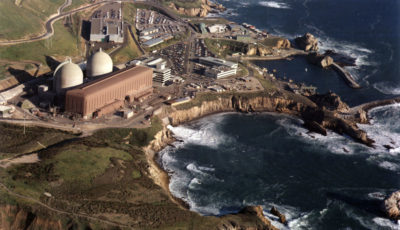
The Diablo Coulee Nuclear Power Plant, located near Avila Beach, California, will be decommissioned starting in 2024. Pacific Gas and Electric
"The average constructive doses" of radiations from Chernobyl, UNSCEAR also concluded, "due to both external and internal exposures, received by members of the general public during 1986-2005 [were] about xxx mSv for the evacuees, one mSv for the residents of the onetime Soviet Marriage, and 0.3 mSv for the populations of the rest of Europe." A sievert is a measure of radiation exposure, a millisievert is one-one-thousandth of a sievert. A full-torso CT scan delivers about ten-thirty mSv. A U.Due south. resident receives an average background radiation dose, exclusive of radon, of about 1 mSv per year.
The statistics of Chernobyl irradiations cited here are so depression that they must seem intentionally minimized to those who followed the extensive media coverage of the blow and its aftermath. Withal they are the peer-reviewed products of extensive investigation by an international scientific agency of the United nations. They signal that even the worst possible accident at a nuclear power plant — the complete meltdown and burnup of its radioactive fuel — was yet far less destructive than other major industrial accidents across the by century. To proper noun only 2: Bhopal, in India, where at least 3,800 people died immediately and many thousands more were sickened when twoscore tons of methyl isocyanate gas leaked from a pesticide plant; and Henan Province, in Communist china, where at to the lowest degree 26,000 people drowned post-obit the failure of a major hydroelectric dam in a draft. "Measured as early deaths per electricity units produced by the Chernobyl facility (ix years of operation, total electricity product of 36 GWe-years, 31 early deaths) yields 0.86 death/GWe-year)," concludes Zbigniew Jaworowski, a doctor and former UNSCEAR chairman active during the Chernobyl accident. "This charge per unit is lower than the average fatalities from [accidents involving] a majority of other energy sources. For example, the Chernobyl rate is ix times lower than the death rate from liquefied gas… and 47 times lower than from hydroelectric stations."
Radioactive waste disposal, although a continuing political problem, is not whatever longer a technological problem.
The accident in Nippon at Fukushima Daiichi in March 2011 followed a major earthquake and seismic sea wave. The seismic sea wave flooded out the power supply and cooling systems of three power reactors, causing them to cook down and explode, breaching their confinement. Although 154,000 Japanese citizens were evacuated from a 12-mile exclusion zone around the power station, radiations exposure across the station grounds was limited. Co-ordinate to the report submitted to the International Atomic Energy Agency in June 2011:
"No harmful wellness effects were found in 195,345 residents living in the vicinity of the constitute who were screened by the end of May 2011. All the one,080 children tested for thyroid gland exposure showed results inside safe limits. Past December, government wellness checks of some 1,700 residents who were evacuated from three municipalities showed that two-thirds received an external radiation dose within the normal international limit of i mSv/year, 98 percent were beneath 5 mSv/year, and 10 people were exposed to more than than 10 mSv… [There] was no major public exposure, allow lone deaths from radiation."
Radioactive waste disposal, although a standing political problem in the U.South., is non any longer a technological problem. Near U.S. spent fuel, more than ninety percent of which could be recycled to extend nuclear ability production by hundreds of years, is stored at present safely in impenetrable physical-and-steel dry casks on the grounds of operating reactors, its radiation slowly failing.
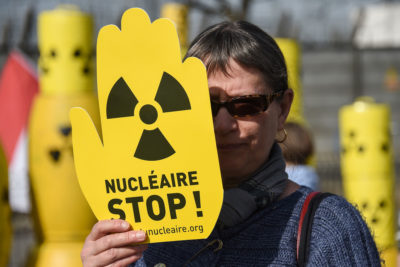
An activist in March 2017 enervating closure of the Fessenheim Nuclear Ability Plant in France. Authorities announced in April that they volition close the facility by 2020. SEBASTIEN BOZON / AFP / Getty Images
The U.S. Waste Isolation Pilot Plant (WIPP) about Carlsbad, New Mexico currently stores low-level and transuranic military waste and could store commercial nuclear waste material in a two-kilometer thick bed of crystalline table salt, the remains of an ancient sea. The salt formation extends from southern New Mexico all the manner northeast to southwestern Kansas. It could hands accommodate the unabridged earth's nuclear waste for the side by side 1000 years.
Finland is fifty-fifty further avant-garde in carving out a permanent repository in granite bedrock 400 meters under Olkiluoto, an isle in the Baltic Sea off the nation's west declension. It expects to brainstorm permanent waste product storage in 2023.
A final complaint against nuclear power is that it costs too much. Whether or non nuclear power costs too much volition ultimately be a thing for markets to decide, but there is no question that a full accounting of the external costs of unlike energy systems would observe nuclear cheaper than coal or natural gas.
Nuclear power is non the but answer to the world-calibration threat of global warming. Renewables have their identify; so, at least for leveling the menstruum of electricity when renewables vary, does natural gas. But nuclear deserves meliorate than the anti-nuclear prejudices and fears that have plagued it. It isn't the 21st century's version of the Devil's excrement. It's a valuable, even an irreplaceable, part of the solution to the greatest energy threat in the history of humankind.
Source: https://e360.yale.edu/features/why-nuclear-power-must-be-part-of-the-energy-solution-environmentalists-climate
0 Response to "How Is Nuclear Energy Affecting the Environment Peer Reviewed"
Post a Comment